Swiss long-haul travel specialist for over 50 years
Aboriginal tours

Tours with Aboriginal guides
Tours with Aboriginal guides
On excursions and activities with the first inhabitants of the fifth continent, you experience Australia in its most original form. Aboriginal Australians belong to one of the oldest and most diverse cultures in the world and have lived on the continent for over 40,000 years. Their heritage lives on in rock paintings thousands of years old, in stories passed down from generation to generation and in traditional bush tucker cuisine. Today there are around a hundred different tribes in Western Australia, which in turn comprise more than 60 language groups. Aboriginal life is also reflected in art: in rock paintings, dot painting, music and dance.
Without doubt, the best way to experience the unspoilt nature and the fascinating ancient culture is in the company of a local guide. Guided walks or 4x4 excursions through the bush give you a first insight into how Aboriginal people live and survive on the land. Your guides introduce you to traditional medicine and bush food. You can also get to know Aboriginal culture at cultural centres such as Kings Park in Perth and Kodja Place in Kojonup.
WAITOC
WAITOC is the abbreviation that brings together a range of tour operators and excursion providers. They give visitors an authentic insight into Aboriginal life without compromising their traditions and culture. A central aspect of Aboriginal culture is the role of Aboriginal people as ‘custodians of the land’. Everything they show visitors is ultimately based on a respectful relationship with nature.
Travel through Western Australia and the Red Centre, home of the famous Ayers Rock (Uluru), with an Aboriginal guide.
Encounters with Aboriginal Australians
At Cape Leveque on the Dampier Peninsula, which can only be reached by four-wheel drive, Brian Lee clambers through the tangle of mangroves, thrusts his iron spear into the mud and in a flash pulls out a mighty pair of claws, which he grips firmly shut: a mud crab. Now it’s the guests’ turn to try their luck at ‘crabbing’. Once the bucket is full, he heads back to shore and lights a campfire in the middle of the dunes. Freshly grilled, mangrove crabs are unbelievably delicious!
UNESCO World Heritage-listed Shark Bay is home to Darren ‘Capes’ Capewell. The Aboriginal people call this place ‘Gutharraguda’ (meaning ‘two waters’); every morning, dolphins come to bathe at the beach of Monkey Mia. The largest dugong (sea cow) colony lives here, and manta rays dance through the waves. By kayak or paddleboard, you can get really close to the marine life. Travel in a small group by 4x4 along tracks and over red dunes to François Peron National Park and take in the scenery: bright green acacias and spinifex and turquoise water – the colours of Western Australia.
‘Nature’s supermarket,’ laughs Darren – and reveals the delicacies of the Australian bush: tomatoes, Illawarra plums and aromatic fruits such as quandongs, lilly pillies and muntari berries. To nibble on, there are acacia seeds, bunya nuts and, in the tropical north, lotus seeds. Surprising, delicate flavours that Darren uses over the campfire to season the fish caught following the tips of the ‘Indigenous Tour Guide of the Year’ (2006), while the guests explore the underwater world of the shallows with mask and snorkel.
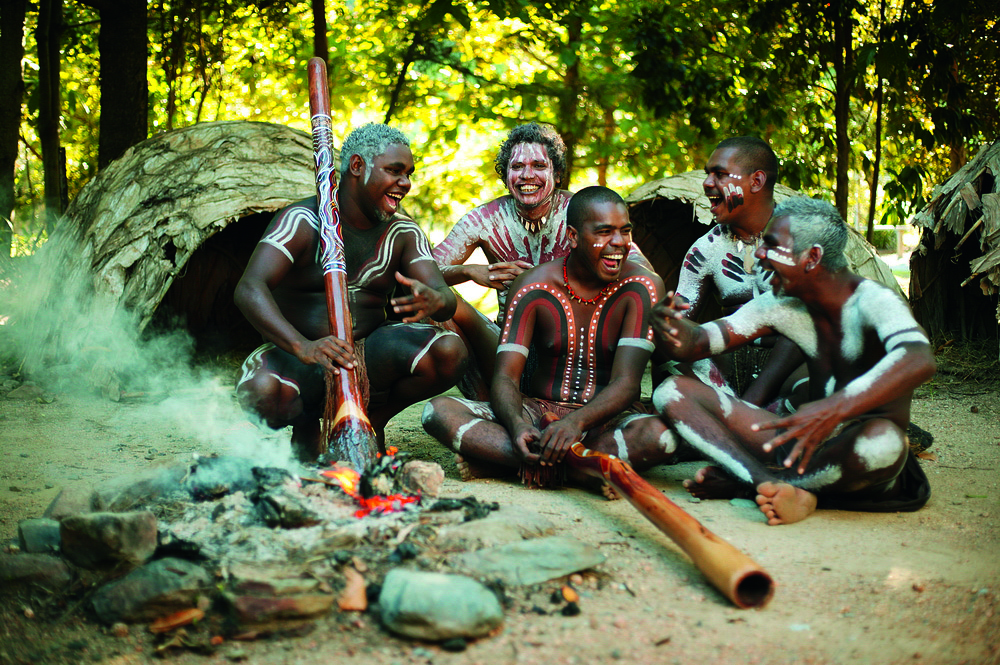
In Dunsborough, Josh, founder of Koomal Dreaming Cultural Experiences, introduces you to the world of the Wadandi and Bibbulman people. He shows you the delicious foods and highly effective remedies the bush has to offer, tells of the Dreaming of a people and, at dusk in Ngilgi Cave, plays the didgeridoo, the musical emblem of Aboriginal Australia. This famous Aboriginal instrument goes by more than 40 names. With their sophisticated blowing technique and a variety of mouth movements, Aboriginal players coax the most astonishing sounds from the hollow trunk. A strict code determines what may be played on the instrument. Sometimes the sounds imitate the vibrations of the mythical Rainbow Serpent, sometimes the movements of an animal, the shape of the landscape or the structure of a leaf – nature sets the rhythm. The sounds are a gateway to the spiritual world of Aboriginal people. The repetition of the rhythms puts the mind into a trance. Present and past, reality and the spirit world merge. The didgeridoo is played on every occasion – to accompany children’s songs, at corroboree dance ceremonies and during sacred, secret rituals. Covering 97,000 km2, Arnhem Land at the eastern end of the Northern Territory is the largest surviving homeland of Australia’s Aboriginal people. Created in 1911 and slightly larger than Portugal, the reserve has been managed by Aboriginal people themselves since the Aboriginal Land Rights Act of 1976. Independent excursions are only possible to a limited extent today – a permit is also required for the Tiwi Islands of Melville and Bathurst and for the Cobourg Peninsula with Gurig National Park, which are already somewhat developed for tourism. The only exception is Nhulunbuy. This small town on the Gove Peninsula in East Arnhem Land is the starting point for deep-sea fishing. Angelfish, Spanish mackerel and coral trout take the bait here. Daliwoi Bay (Daliwuy) is another popular fishing spot. Bremer Island also offers excellent fishing; there, the Banu Banu Eco Wilderness Retreat serves guests their own catch for dinner.
Guided tours and excursions are recommended for anyone wishing to discover the diversity of Aboriginal culture and the varied landscapes of Arnhem Land in an authentic way. Local guides show you rugged coastlines, remote islands, rivers teeming with fish, rainforests and rocky escarpments, savannah woodlands and billabongs that change radically with the seasons and are important refuges for wildlife. Crocodiles and kangaroos, water buffalo and flying foxes are at home here. The art centre of Indigenous culture is Injalak. At the Injalak Art & Craft Centre, Indigenous artists weave baskets and create paintings; on the hill of Injalak near Gunbalanya (Oenpelli), their ancestors immortalised female figures, favourite foods and extinct exotic animals such as the Tasmanian tiger in the rock more than 10,000 years ago. For 50,000 years, paintings and hand stencils have adorned the rock walls of Awunbarna (Mount Borradaile). The 120 m high hill has been a burial site for thousands of years: here the souls return to the source from which they were born. Until a few years ago, outsiders were not allowed to set foot on this sacred Aboriginal mountain. Today, on behalf of the Ulba Bunidj people, the team at Davidson's Arnhemland Safaris shows visitors this spiritual place, set in 700 km2 of wilderness far from civilisation. From the eco-lodge of Mount Borradaile Safari Camp, which even has an internet connection, you hike to the Aboriginal ceremonial stones, clamber through the labyrinth of catacombs, fish for a huge barramundi in the creek, discover the birds and wildlife of the wetlands and enjoy a sunset boat trip on the billabong before the day draws to a close with dinner under the stars: experience Australia with its Aboriginal people!
Our customers’ favourite Aboriginal tours
FREE BROCHURE ORDER
 The travel agencies of the knecht reisen group